Tuesday, May 14, 2013

the bee's knees


It’s been a while, dear friends and family. I’ve been busy, but at the same time, experiencing a whole new level of boredom that I only heard about from other volunteers but I wasn’t able to understand it yet. Now, I can say that general boredom is one of the top things I am struggling with right now. It’s been raining almost nonstop since Sunday, and I can hear another thunderstorm rolling in right now as I type away from my bed in my sleeping bag. I’ve been watching movies from my bed and drinking a ton of mate. I broke up the monotony (of talking to my cat) by having lunch with my neighbors, I brought purple cabbage and carrots for salad that I bought in the Oviedo market, and they served me up a steaming hot plate of rice and chicken. Today is Paraguay’s two-day holiday: Independence Day. Tomorrow is also Mother’s Day, and coincidentally my landlord’s birthday. All the celebrating is a bit dampened though will this persistent rain. I didn't end up in Oviedo yesterday because my bus out of site does not run if it rains this hard, and I missed out on the parade that possibly happened in the plaza there. Next year maybe. 

Okay, but did I mention THE RAIN. My garden is flooded in the corner closest to my house, it has a hole for water collection, but it isn’t enough apparently to hold up to this much rainfall. Yikes! At least most of my veggies I’m growing are loving the water, and I’m loving that I don’t have to water it myself right now. I usually have to take at least 4 trips with my little watering can and it’s a nice break. Right now carrots, beets, kale, swiss chard, onions, and little basil and cilantro plants are coming up. Cukes and tomatoes are flowering! I’ve wanted to try a technique one of my fellow Ag volunteers is using in their garden, which is filling plastic water bottles with water that have holes cut in the lids, and bury them in the seedbeds to have a homemade slow-drip water system. I’ll try it out when it’s drier, definitely not lacking moisture now.

Life has been both interesting and frustrating here in the heart of South America.  In terms of actual work I’m trying to figure out with my women’s committee what project(s) they want to work on, and what they really think the needs are in the community. My first few attempts at using PACA (participatory analysis for community action) tools have gone over mediocrely – I didn’t have the full participation of the committee since not everyone shows up, and then its hard to keep their attention after they have the cooperative representative give a presentation first. I also have been identifying families that are excited about working with me outside of the women’s committee, and some are just so kind and generous to me it’s overwhelming.

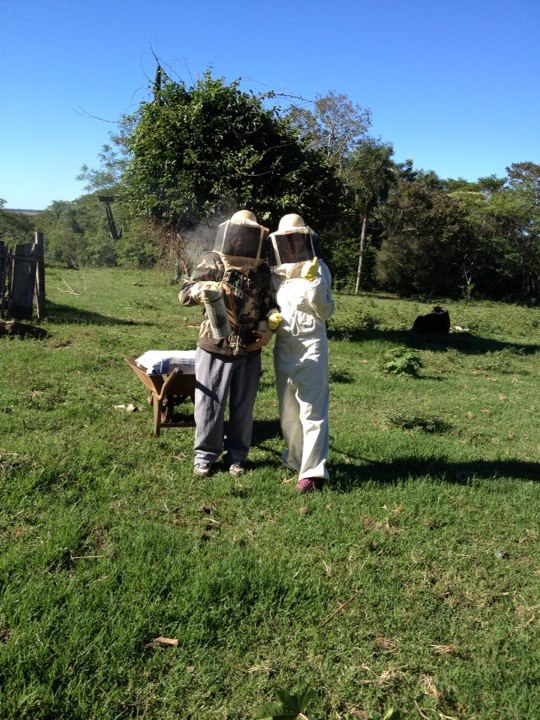
I know one family aside from my first host family that cares for bees, and I will hopefully get more comfortable and better at beekeeping. I had a memorable experience the most recent time with my host dad – this photo is before we headed out to the hives, in my astronaut suit (ha!), and before I felt like my arm was going to explode. We started in one hive that has needed new frames for some time, and my host dad had been waiting for me to help him do it, apparently. Well, it had been well overdue and the hive just started making their own comb from the lid of the bee box, and it was a huge mess.  I am still learning beekeeping, and as he asks me (in Guarani) what I think we should do I realize it’s one of those “I have no idea what I’m doing” Peace corps moments – as hundreds of buzzing bees are flying around me, even more crawling on the ground at my feet from the comb we were breaking off. As the sweat drips down my back, I take a deep breath, swallow hard, and say with conviction, “we’ll just do what we can!” We ended up putting in only 3 out of the 5 frames we had prepped, and harvested quite a bit of honey that they had been producing sans frames. (Side note: it was some of the most delicious honey I’ve tasted as of yet.)
At this point, the bees were getting pretty angry, and also were massing near and on the bucket we were putting the honeycomb into. I brought back a wet towel to use as a lid, but there were SO MANY BEES. I started getting nervous, and then when I started to get stung through my crappy yellow dishwashing gloves I started getting panicky. I held myself together until we started harvesting honey from a second hive that already had its frames – that’s when I just started getting stung way too much for me to handle. Most of the stingers I felt didn’t get their way under my skin, but man, they hurt! I got three or four stings on my arm/wrist and two on my fingers, and all of a sudden, I felt like I couldn’t feel my hand. I got a little woozy and then really started to panic that I was having an allergic reaction. I couldn’t remember where my epi-pen was, and I didn’t want to have to use it. So I ended up going back to the house, and completely freaked out my host mom because I was all sweaty and white in the face and saying I couldn’t feel my hands.  After downing some anti-allergy medicine they found in the fridge, and drinking some water, it was clear I wasn’t going into epileptic shock. This just was the first time I’ve received that many bee stings, ever! Now I know what it feels like, and I think the bees could sense that I was on edge. Also, when bees sting it sends out a pheromone that if you don’t cover up with smoke, will attract more bees. Hence why I kept getting stung in the same area. So alas, I live to tell the tale, and my freak out now is a story to laugh at (again, and again, and again) with this family and all of their extended family. Oh, lord. Nothing is a secret here, that’s for sure.

I’ve been visiting and working at the local primary school about once a week, but things happens that impede getting actual work done. Right now, it’s the weather. It’s also holidays, a teacher strike, and just general miscommunication that have kept a hold on projects I’ve been trying to do with the kids and teachers there. We started the school garden, and there are now two beds and one of them is planted! So that’s exciting, and it’s a collective effort – every kid will be bringing in compost/manure to use in the garden, and a bunch of the parents helped clear and prepare the space for planting. The only thing is that the work I’ve been doing has been disjointed, and there are over 30 kids in the afternoon. So it’s been a challenge to actually have a “lesson” with the kids in the short time I’m there and I don’t know which classroom out of the five classes to spend the most time in. I will figure it out, I’m sure. Things just happen a lot slower here – everything is “en seguida” which is Spanish for either “in a bit” or really a nicer way of saying (without actually saying) “it’s never gonna happen”. Kids are only in school for about 4 hours at a time each day, and some of that time is recess and snack, it’s crazy! Being here has me thinking differently about our education system in the US and internationally.

The rain and thunder has started back up again since I paused on finishing this blog entry; it’s relentless! I hope you enjoyed a little glimpse into my life here in La Novia, Caaguazu, PY.  Things are more interesting when I spend time with the people that want to work with me, and I definitely have the most stories with the first host family I lived with when I first moved here.  More to come, lots of love to everyone at home and wherever you may find yourself! Xox 


Thursday, April 4, 2013

the sweet things in life

Hola de nuevo :) Hello again. I hope that wherever you are, this finds you well. Happy (belated) Easter! Felices Pascuas! I hope this finds you well, dear reader, and that life is going swimmingly. Greetings from Paraguay, where the weather is finally cooling down some - and it actually feels like fall may be starting. We had some cold spells, and then for about a week it got hot and HUMID again, and basically it's rained on and off again this whole week. It rained so hard on Monday through the night, that the bus that passes through my community was not running. Which isn't out of the usual after a rainstorm, but I thought that our rainy season had already come to a close. That just meant I pushed back a day my morning trip into Oviedo with a fellow agriculture volunteer. I was able to go in yesterday and I made some relatively big purchases since I just got my monthly stipend for April - a ropero (an armoire - see photo on left), bedsheets, a wheelbarrow, and lots of food/things for my house! I will post pictures next time of the changes in my room and how my garden is coming along :) 

For this post though, I wanted to talk about food. Namely dulce de guayaba and chipa. I experienced my first Semana Santa in site, which is holy week in the Catholic religion here - more on that later. First, let me explain the process of making dulce - which is jam making basically, but campo style. 

1. First, you have to harvest your fruit! This is my neighbor/host sister Mariza shaking down some guayaba fruit - they have a little forest of guayaba trees in their backyard - essentially, my backyard too. There was tree climbing, lots of laughs, and it was raining guayabas. The season for fruiting just ended, and there was so much fruit that a lot of it is fermenting and rotting on the ground. 


2. After harvest, you clean in water the fruit and then cut and scoop out the seeds. If you're just eating a guayaba fresh from the tree, you eat it all - seeds and all, some are small and you just pop the whole thing in your mouth. But, for the dulce making you only want the inner flesh and the outer skin.


3. From here, you add all of your cleaned and gutted guayaba to a pot with some water to boil until very soft. This is the fogone, the wood stove at my neighbors house. 


4. After the fruit is totally cooked and mushy, you let it cool for a bit and then start blending! There were two blenders involved in this endeavor, and I think we had around 6 kilos of fruit. You want the blended fruit to be as smooth as possible for best results. 


 5. Next, comes the actual cooking, with sugar! I think that they may have added 1:1 sugar to fruit. Which, is a bit alarming to me. I saved a blended batch of fruit to make with honey (miel de abeja), and had about the amount that you see above in the blender. I added one cup of honey, and cooked it the same way as you do with sugar. Below, this is the cooking process over a fire outside of the house. It took 3-4 hours to totally cook down, and it turns this gorgeous deep reddish color from the very pink raw fruit. You want to keep stirring, and we added marbles to the honey sweetened version to avoid getting burned by the boiling!


6. Finally, after the dulce has thickened and turned this deep color, you let it cool and then enjoy! Paraguayans mostly have their dulce de guayaba on bread with their morning cocido (a burnt mate milky hot beverage) or just as a snack on again, bread. I enjoyed my dulce de guayaba (with honey) on fresh banana bread! I ate it so darn fast, and I want to make more!


It was a long process, but it was totally worth it. The only thing is that sugar is cheap, and honey is not. Paraguayans in the campo are not about to buy honey (it's around $8 per kilo for honey, and a dollar for a kilo of sugar?) So, unless someone has a hive with plenty of honey that they aren't selling, they aren't about to make dulce with honey instead of sugar. They doubted that it would turn out as rico (delicious) but I had some of my neighbors try it and they thought it tasted the same! Success :) There are endless benefits of removing excess sugar from one's diet, and replacing it with a local resource that is full of immunity boosting properties and totally natural. The amount of sugar added to beverages (like juice! fruit is already sweet, but soo much sugar is added every time) and things like dulce de guayaba is staggering, and it's not a surprise that diabetes is a major problem in people's health in my community and all over Paraguay. People are not necessarily overweight, but they are consuming way more sugar than is recommended, that's for sure. I hopefully will be working on nutrition charlas (lessons) in the primary school, and being part of the education process for nutrition and healthy eating. 

Alright, next up in my foodie blog tonight - CHIPA! There is no shortage of chipa in the campo during Semana Santa. Literally every family is making it. Here is Na Digna preparing the masa (the dough) for chipa - which consists of mandioca flour, corn flour, eggs, pig fat, old campo cheese (it has to be old, it has more flavor), salt, and I think that's it. Totally gluten free, but not fat free that's for sure! They make SO MUCH dough it's absurd, to make hundreds of little chipas. 


Here is the chipa making process, you roll out the dough with your hands, and then pull off a chunk and roll it into the desired shape. Some families have their favorite shape, and I just tried making them all! Even a heart :) 

Next, you put your chipa on top of banana leaves (if you can see above, they are on top of cut pieces) and then put them in the blazing hot brick oven that every household has. Some do it one by one, and others on baking sheets of sorts as to save time. Here is me taking out hot chipa from my neighbors oven, and some of the finished product! Delicious hot, not as good when it's days old and rock hard. Although, I have reheated my chipa in the oven, and it still does taste pretty good. 


Chipa is the most important Semana Santa tradition, and I basically went from house to house on my bike, visiting families, making chipa, drinking terere, and getting gifted more chipa then I could ever consume in my lifetime, seriously. Thankfully a family I know took a big bag of it - I think I had more than 30 - because they didn't have any left on Saturday after making it on Wednesday that same week. I still have some in my fridge- and just tonight, my neighbor took 3 home with him! Oh, Paraguay. 

The cultural differences between the Easter holiday celebrated in the US (and in my family) and here are many. This whole week was Semana Santa, or holy week, and almost everyone is off of work or school, and stays home to make hot chipa and spend time with family. There are many different church activities, and for the teenagers who are going to make their confirmation (I think) they have 3 days of “Pasqua Joven” at the church in the town next to me.

So it's been a busy and fun past couple weeks in site, but also Easter made me SUPER homesick. I miss the US and my many different homes, and I especially miss the people I love that are living out their lives and just doing their thang. The hardest part of being here is just not being able to SEE my family and friends from back home (and actually, even new volunteer friends) when I want to. I’ve gotten somewhat used to that living in California, but now I think this is officially the longest I’ve gone without seeing family in my life – it’s been a few days over 6 months now since I’ve moved abroad! However, I was able to “see” a bunch of my family for Easter over skype – which was amazing J I showed them all my house, my yard, my garden, and they met my neighbors – my new family that I live next to.  It was wonderful. Glenn, my brother, played guitar and tried to create a song in Spanish for my neighbors to understand! It was hilarious. We even did joint virtual egg fights! More on easter soon, my internet won't let me put up any more pictures right now. Here is a picture below of me with one of my community contacts, Lucia. We went on a mini adventure in the chacra of one of her uncles in La Pastora, around 25k from my community. Wearing flowers that my mom sent me for Easter! 


The sky was beautiful, and I will leave you with this photo from our walk. Lots of love and hugs! More soon :) XOXO


Wednesday, March 13, 2013

long overdue updates!


dear friends and family, i am long overdue for a blog post. i apologize for my lag in writing! I’ve been writing in my journal, a lot, but haven’t had the time or mental space to sit down and write a complete entry here. I really tried a few times – for instance, on February 10th when I was staying at a hostel. I wrote:

hello dear ones. Hola from asuncion, el capital. I am writing from the back yard of a lovely little hostel in the Centro. This weekend I went into the city after being in my site for over a month and not leaving! I am proud of myself.

And it stopped there. It was an attempt! I think I was too distracted, going to Asunción is its own culture shock coming from the campo, and there is just so much to talk about when I’m finally hanging out with other volunteers, and speaking English. 

I think it may be easier for me to list some updates and random experiences I’ve had over the past few months of being in my community:

11.   I moved into my own little casita! I live in a little house that used to be the grandmother’s of the Gonzalez Garcia family, which is on their property. This means I basically have a whole new family – with 7 sisters and one brother, and one of the sisters (she’s also 25) has a 4-year old girl. It’s wonderful to have my own space, but I’m even more in the “fish bowl” because everybody (the family, and neighbors) visits, wants to know what I’m doing at every second, and can watch me as they pass by or just gawk from their front yard. I shouldn’t complain, really, because it usually means I get free food with every visit.  Living on my own also means that I cook my own (vegetarian!!) food, and eat when I want. I love my brand new little oven with two burners. I’ve been baking a lot of pan dulce de banana (banana bread) and random other things it’s wonderful. I’ve been sharing my food I cook a lot too (especially pan dulce and cakes) – and I think will be the main way that I bond with the family and neighbors, through food.


32.  I’ve finally gone back to no meat, except for when I eat with families I visit and they feed me more chicken then I could ever eat in one sitting. I basically am known now to not eat any meat, and I’m glad for it. When I lived with families in their homes I tried almost everything, including pig intestine, fried pig fat, cow organs, cow neck meat, crocodile, eel, and I’m sure other things I couldn’t identify. I still haven’t had armadillo, but it’s common apparently to eat in the campo. I have some chicken frozen in my freezer right now that was given to me as a gift, and I think I’ll save it for when I have some other volunteers visit. It’s been a very weird experience, this eating meat business, and Paraguayans just don’t really understand a vegetarian diet. The most popular dish for any kind of party or special occasion is asado (BBQ) of either pig or cow, with mandioca, sopa paraguaya (kind of like corn bread) and rice salad that has the teeniest amount of vegetables and a TON of mayonnaise.

(This is a photo from my host sister's 15th birthday bash - can you spot the pig head?)

43. I started my own garden next to my house with the help of some awesome community members. I’ve been slowly getting it prepared to plant tons of veggies – so far I have a starter bed with onions and lettuce that aren’t doing so well with the heat, and seedlings I’m waiting to coming up of tomatoes, cucumbers, squash, kale, beets, and something else I cant remember. I also have one little cilantro plant I transplanted from the first host family’s garden. I’m excited to grow things although it’s also a lot of pressure – if things die or don’t go well, everyone will know about it. On the other hand, if my permaculture techniques are wildly successful – everyone will know about it. It’s a little Peace Corps technique – using a demo plot to experiment with sustainable gardening and agricultural practices and thus demonstrate them to the community. Wish me luck!

54. I’ve been continuing my English and yoga classes, although right now my yoga “classes” have been just me and a couple of my hermanas at my house doing yoga in the evening. It’s getting dark earlier now, and its’ hard to get my students to stay for yoga after English class lately. There are fewer students now, but the ones that come almost every class remember a lot, and it’s so amazing to see the learning process! It makes me think about teaching in the future, and definitely appreciate the teachers I know in my life – it’s hard work.


There’s so much more to write about, but it’s time for bed right now – it’s after 10pm. I think I’m waking up early to go and harvest cotton with my neighbor Edgar and his wife Lili – they are in their early 30s. I had dinner with them tonight and the family which was a shared meal of some squash/potato soup I made last night and a Paraguayan dish that is basically a corn mash with cheese. My next blog entry I will be describing (with photos) how I made dulce de guayaba (guava jam) with some of the sisters today. I haven’t cooked the small amount I saved to try to sweeten with honey instead of sugar yet (they used 3 kilos of sugar! for 6 kilos of guava). More food talks soon, especially about the staggering amount of sugar that is in the diet here. 

Hope this finds you well and lots of love :)

Monday, January 14, 2013

el tarde es largo (the afternoon is long)


Buen dia! I’m writing from Coronel Oviedo, where I am for the day and night to have a meeting and down-time with some fellow peace corps volunteers that are in my VAC (volunteer action committee?) and live in the same area of Paraguay. I’ve been in my site for over a month now and the integration thing is getting easier – although there are things that I am still struggling with and probably will for most of my service. I’ve been moving around a bit now – I haven’t moved myself entirely but I am in the process of moving to a new family’s house that is close to the center of La Novia and right across the street from the Club Social which is a meeting place and entertainment space basically in the community. It’s super lindo and has a nice brick floor space that I have now started to use for my evening yoga classes! (Check my facebook for pictures!)

I talk about yoga with basically everyone in my site because I really want to get exercise myself and also work on health and nutrition especially with kids and women here. An idea was born to start teaching yoga after my newly started English classes that I’ll be holding right now four times a week. It was incredibly inspiring and also overwhelming to be in front of so many Paraguayans who are eager to learn and also think everything I do is just hilarious or curious. I just happened to go to Nueva Londres (the small town next to La Novia) one day last week, and my Paraguayn friend Marizol took me to the local radio station to talk to one of the radio hosts, Rafa, and see if I can eventually do some work with the radio station. He ended up interviewing me on his show (called Amistad y Tradicion) and I announced that I was starting English classes and also teaching yoga at the club social in La novia. Since that morning, he’s been announcing the class and so on Thursday evening for the first one – 30 people showed up! It was crazy, I didn’t even realize how much of an influence the radio could have. Young people from 7 years old to 20 something and also some senoras came from 3 of the neighboring pueblos and also from the La novia. We started with the alphabet, and I’ve never taught English in my life except for a few words here and there through my travels in Latin America. We shall see how it goes! There are peace corps materials I have available to me to use for lessons, so I’ll be going off of those and then just what my students (!!) are excited about learning or need/want to work on. I’m excited to already have a side project, and especially because it involves also doing lots of yoga as well.

All in all I am in a great place right now and although I miss vegetables terribly and Guaraní gives me the worst headache - especially at the 2-hour long women’s committee meeting where 25 senoras are talking over each other in guarani and change subjects every 2 minutes – and I’m happy about (probably too much so) having working internet in my site finally. It’s not the fastest internet ever, and I think skyping may be too hard to do with the connection. But expect me to be in touch more now! Although I shouldn’t be spending all my time on the internet. It’s just so damn hot out all the time so taking a 3 or 4-hour siesta is totally legit. At least in my book. 

Oh and one last on my title for this entry - it's a phrase I've heard a lot here at lunch time when I say that I can't eat all that I'm given on my plate. "The afternoon is long" - so you better eat up basically, since dinner isn't til 8:30pm and most Paraguayans just eat milk and bread or fried tortillas for dinner. Luckily my meals have been mostly vegetarian (which means chicken usually) and there's also a merienda (snack) at some point in after my siesta. I definitely am not going hungry here, that's for sure. Anyways, more soon loves hope all is well.